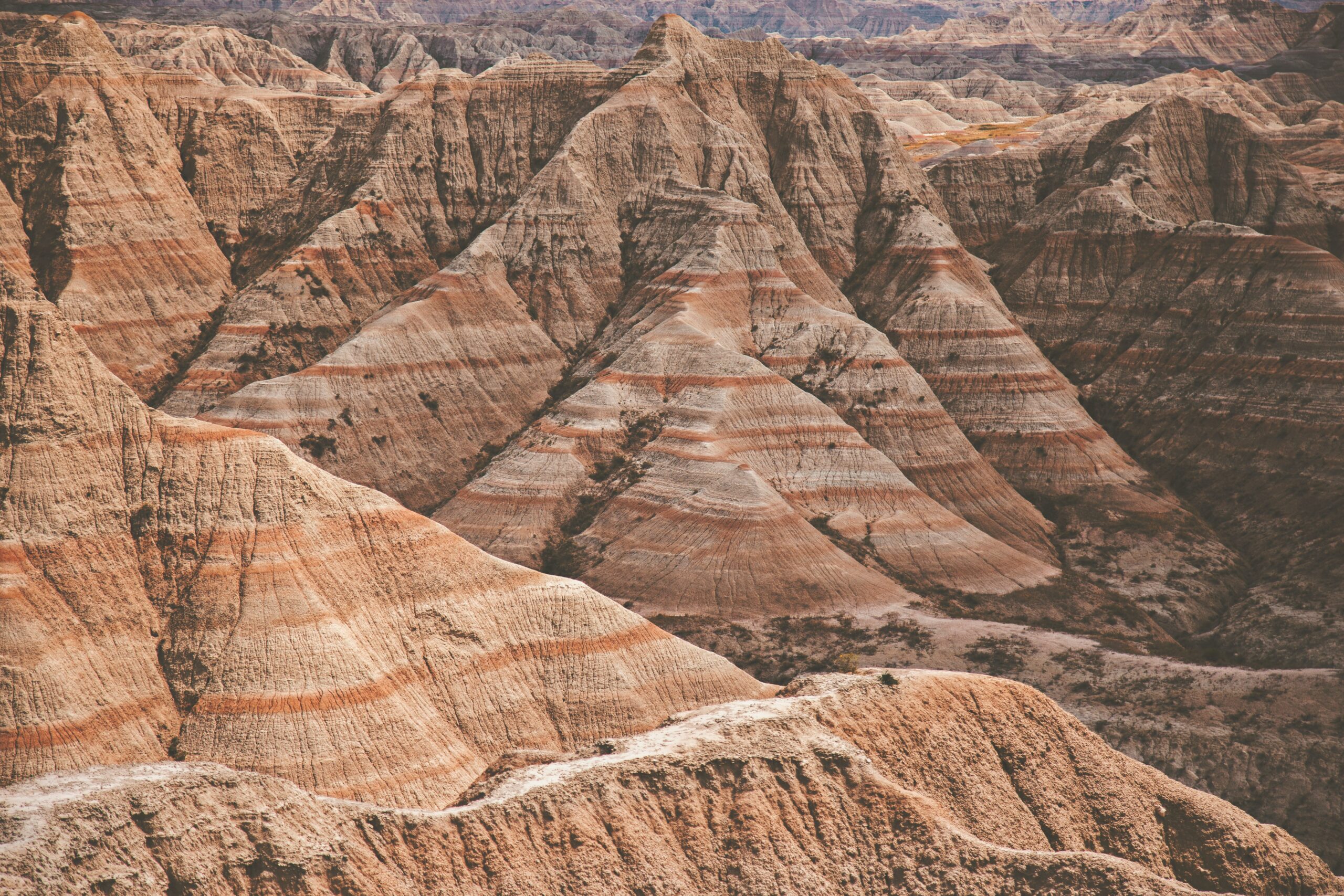
People arrive in the Badlands looking for dinosaurs and leave slightly confused. Here is the honest answer: there are no dinosaurs here, because when the dinosaurs were alive this place was underwater. What the Badlands has instead is three completely different worlds stacked on top of each other, a Cretaceous sea, a subtropical swamp, and an open savanna, and you can see the boundaries between them with your own eyes in the banded cliffs.
You can also watch paleontologists cleaning fossils out of that rock at the Ben Reifel Visitor Center, which is something no other national park lets you do.
Three worlds, bottom to top
1. The sea, Pierre Shale, about 75 to 69 million years ago
This is the oldest rock in the park, sitting at the base of everything. This is Cretaceous, properly the age of dinosaurs, but South Dakota was at the bottom of the Western Interior Seaway, a shallow ocean that split North America in two.
So the animals preserved in it are marine: ammonites, and mosasaurs, enormous predatory marine reptiles, some of them longer than a bus. A mosasaur is not a dinosaur, which is the technicality most visitors trip over. It is a giant sea lizard that lived at the same time.
That is why there are no T. rex bones in this park. That is not bad luck, it is the wrong address.
2. The swamp, Chadron Formation, about 37 to 34 million years ago
The sea has gone, and what replaced it is pale gray claystone laid down on a hot, wet floodplain, so the closest living comparison is the Everglades. Think alligators and turtles rather than sagebrush.
3. The savanna, Brule Formation, about 34 to 30 million years ago
This is pinkish banded siltstone and sandstone. The swamp has dried into open grassland cut by seasonal rivers, and this is the layer that made the Badlands world-famous, one of the richest records anywhere of the mammals that took over after the dinosaurs.
When you look at a Badlands cliff, you are looking at that entire sequence, ocean floor to swamp to prairie, written down in mud.
What lived here after the sea drained
- Oreodonts, sheep-sized plant eaters, by far the most common fossil in the park. Oddly, they have no living descendants at all. An entire successful family came to an end.
- Archaeotherium, an entelodont, nicknamed a “hell pig”. It was heavy-skulled and omnivorous, and it is the one everybody remembers.
- Mesohippus, an early horse the size of a large dog, with three toes on each foot.
- Subhyracodon and Metamynodon, rhinoceroses, neither with a horn. One built for running, one semi-aquatic.
- Nimravids, saber-toothed predators about the size of a bobcat.
The Big Pig Dig, and the mistake in its name
The most famous excavation in the park started by accident. In June 1993, two visitors from Iowa noticed a large backbone sticking out of the ground near the Conata Picnic Area.
The first bone was identified as Archaeotherium, the pig-like animal, and the site was nicknamed the Big Pig Dig. It stuck. Then the fossil was re-examined and turned out to be Subhyracodon, a rhinoceros.
The name was already famous by then, so the Big Pig Dig is named after an animal that was not there. Over fifteen years of excavation the site produced more than 19,000 fossils across roughly nineteen species, three-toed horses, small deer-like animals, turtles, and a bobcat-sized saber-toothed cat.
What paleontologists want
Visitors want the big skull. Researchers want something else entirely: small mammals.
Tiny animals, early rodents, insectivores, the small and unglamorous end of the fauna, are the most sought-after fossils in the Badlands, and they are rare. Small bones are fragile, they scatter easily, and they weather away fast once exposed. A rhino skull survives being buried and re-exposed. A mouse jaw usually does not.
Which is exactly why they matter. Small mammals reproduce and evolve quickly, so they record environmental change in much finer detail than the large animals do. They are the resolution in the picture.
The Fossil Preparation Lab
Inside the Ben Reifel Visitor Center, park paleontologists and interns work on specimens recovered from the park while the public watches. They free bone from rock, identify species and catalog what they find, and you can talk to them while they do it. If you are visiting with children, the lab is the centerpiece of our Badlands with kids guide.
Plenty of museums display finished fossils. This is the work itself, in progress, in the park the fossils came from.
Hours: 9:00am to 4:30pm, seven days a week, from the second week of June through the third week of September. Outside that window the lab is closed, worth planning around if this is why you are coming.
The Fossil Exhibit Trail
A short, fully accessible boardwalk with exhibits along its length showing what was found here and what those animals looked like. It is flat, quick, and the best orientation to the park’s fossil story. Do it before the visitor center rather than after.
The park is still producing fossils
The Badlands erodes fast, that is why it looks the way it does. Every storm strips material away and exposes bone that has been buried for tens of millions of years.
A fossil you walk past today may have been invisible last spring, and may be weathered to nothing in a few more years if nobody reaches it. This is not a finished museum. It is an active site that keeps handing over new material, which is also why the Big Pig Dig was found by two people on a picnic.
If you find something
- Do not pick it up. Fossils are federally protected inside the park. Collecting is illegal.
- Do not dig around it.
- Photograph it where it lies, note your location as precisely as you can, and tell staff at the visitor center.
A fossil’s scientific value is mostly context, which layer, what position, what lay around it. Lifted out and put in a pocket, it becomes an interesting rock and nothing more. The Big Pig Dig exists because two visitors reported a bone instead of taking it.
“But what about Sue?”
It is the question we get most, so: Sue is real, Sue is South Dakotan, and Sue is not from here.
The largest and most complete Tyrannosaurus rex ever found was discovered on August 12, 1990 near Faith, South Dakota, well north of the park, and excavated by the Black Hills Institute in Hill City. After a long legal fight, the story told in the documentary Dinosaur 13, she was sold at auction and now stands in the Field Museum in Chicago.
Different place, different rock, different era: Sue is Cretaceous, and the Badlands fossil beds are roughly thirty million years younger. But she is a fair reason South Dakota has the fossil reputation it does, and the Hill City connection is a short drive from the Black Hills if you want that side of the story too.
Seeing it with someone who knows the layers
Unlabeled rock does not announce itself. The line between the ancient seabed and the swamp above it is right there in the cliff face, and almost every visitor drives past it without knowing what they are looking at.
Our Wildlife Tour covers the geology and fossil story alongside the animals, and the Sunset and Golden Hour Tour reaches the formations when low light makes the banding obvious instead of washed out, which is when those three worlds are easiest to see.
Every tour is private to your group, so the amount of geology is yours to set. Call 605-252-9100 if you want a trip weighted toward the fossil sites.